17 Sep 2026
10 Sep 2026
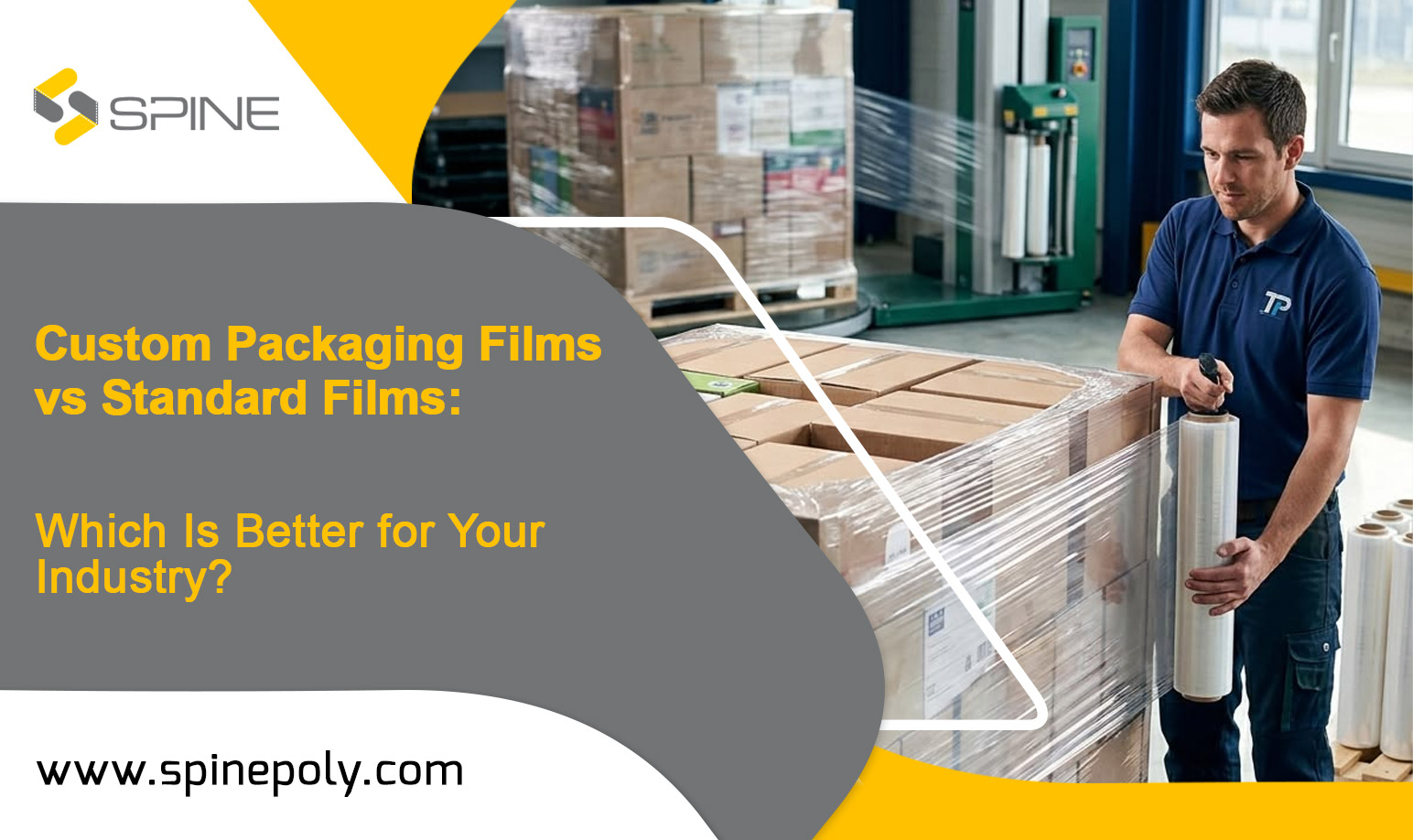
Custom Packaging Films vs Standard Films: Which Is Better for Your Industry?
Packaging film is one of those decisions businesses often make quickly and revisit slowly usually only after a shipment gets damaged, a product loses shelf life early, or a customer complains about how a package looks. At Spine Poly Tech, we work with manufacturers across food, pharmaceuticals, textiles, industrial goods, and consumer products, and the question we hear most often is simple: should you go with standard packaging film, or invest in a custom solution?
The honest answer is that neither option is universally “better.” The right choice depends on your product, your industry’s regulatory demands, your budget, and how much your packaging needs to do beyond simply holding a product together. Here’s a practical breakdown to help you decide.
What Standard Films Actually Offer
Standard packaging films are pre manufactured in common thicknesses, widths, and material grades typically polyethylene (PE), polypropylene (PP), or BOPP. They’re built for general purpose use and produced in bulk, which is exactly why they remain popular.
Strengths of standard films:
- Lower cost per unit — because they’re mass produced without custom tooling or formulation changes
- Fast availability — no design or development lead time
- Proven performance — widely tested for basic sealing, moisture resistance, and general durability
- Simplicity — ideal when packaging is purely functional, not a branding tool
Standard films work well for businesses with straightforward packaging needs: dry goods, hardware components, basic retail wraps, or internal industrial packaging where appearance and specialized barrier properties aren’t priorities.
Where Standard Films Fall Short
The limitations show up when your product has specific requirements that generic film wasn’t engineered to handle. Common gaps include:
- Inadequate barrier protection against oxygen, moisture, or UV light for sensitive products
- No branding surface plain films don’t support strong shelf presence
- One size fits all thickness that either wastes material or under protects the product
- Limited compatibility with automated packaging lines requiring precise film specifications
- For industries like food processing, pharmaceuticals, or electronics, these gaps aren’t cosmetic; they directly affect product safety, compliance, and shelf life.
What Custom Films Bring to the Table
Custom packaging films are engineered around your product’s actual requirements; its sensitivity to light or moisture, its weight, its shelf life target, its regulatory environment, and its branding needs. This can involve adjusting film composition (multi layer laminates, specific resin blends), thickness, opacity, printability, and barrier coatings.
Key advantages:
1. Product specific protection — Films can be engineered with tailored oxygen transmission rates (OTR) and moisture vapor transmission rates (MVTR) to match exactly what your product needs, rather than over or under protecting it.
2. Brand differentiation — Custom printing, finishes, and structural design turn packaging into a marketing asset, which matters enormously in retail and consumer goods where shelf appeal drives purchase decisions.
3. Regulatory compliance — Pharmaceutical and food grade packaging often must meet specific certifications (such as FDA or food contact safety standards). Custom films can be formulated to meet these requirements precisely, where standard films may not.
4. Machine compatibility — High speed packaging lines often need films with exact tensile strength, thickness tolerance, and sealing characteristics. Custom films can be matched to your specific machinery to reduce downtime and material waste.
5. Long term cost efficiency — While the upfront cost is higher, reduced product spoilage, fewer returns, and less material waste from over engineering standard film often make custom solutions more economical over time.
Industry-by-Industry: Which Makes More Sense?
Food & Beverage: Custom films are usually the better investment. Shelf life, freshness retention, and food safety compliance depend heavily on barrier properties that standard films rarely provide out of the box.
Pharmaceuticals: Custom is close to mandatory. Moisture and light sensitivity, tamper evidence, and regulatory documentation typically require engineered film solutions.
Textiles & Apparel: Most basic protective wrapping can be done with standard films, but brands looking to invest in retail presentation can use custom printed films for their higher end product lines.
Industrial & Hardware: Standard films are often sufficient, especially for internal packaging or non-perishable parts where the requirements for protection are minimal.
Consumer Electronics: A mixed approach works well with custom films for anti static or moisture sensitive components, standard films for bulk internal packaging.
E-commerce & Retail: Custom films increasingly make sense as brands compete on unboxing experience and product protection during shipping, where damage and returns carry real cost.
Making the Decision
A useful way to approach this is to ask three questions:
- Does my product have specific protection needs (moisture, oxygen, light, temperature) that generic film can’t reliably meet?
- Does packaging play a role in my brand or customer experience, or is it purely functional?
- Do I have the volume to justify custom tooling and development costs, or does my current scale make standard film more practical?
If your answers point toward specialized protection, brand visibility, or regulatory compliance, custom film is worth the investment. If your packaging is functional, low risk, and cost sensitive, standard film remains a smart, efficient choice.
Our Approach at Spine Poly Tech
We don’t push one solution over another, we start by understanding your product, your industry’s compliance requirements, and your production line before recommending a film structure. Sometimes that means a standard film grade that already meets your needs cost effectively. Other times, it means developing a custom multi layer film engineered specifically for your product’s barrier, strength, and branding requirements.
The right packaging film isn’t the cheapest one or the most advanced one; it’s the one that matches what your product and industry actually demand.
Recent Posts